NOTE: This document was originally written by jrandom in 2003. While we strive to keep it current, some information may be obsolete or incomplete. The transport and cryptography sections are current as of 2025-01.
Introduction
I2P is a scalable, self organizing, resilient packet switched anonymous network layer, upon which any number of different anonymity or security conscious applications can operate. Each of these applications may make their own anonymity, latency, and throughput tradeoffs without worrying about the proper implementation of a free route mixnet, allowing them to blend their activity with the larger anonymity set of users already running on top of I2P.
Applications available already provide the full range of typical Internet activities — anonymous web browsing, web hosting, chat, file sharing, e-mail, blogging and content syndication, as well as several other applications under development.
- Web browsing: using any existing browser that supports using a proxy.
- Chat: IRC and other protocols
- File sharing: I2PSnark and other applications
- E-mail: susimail and other applications
- Blog: using any local web server, or available plugins
Unlike web sites hosted within content distribution networks like Freenet or GNUnet , the services hosted on I2P are fully interactive — there are traditional web-style search engines, bulletin boards, blogs you can comment on, database driven sites, and bridges to query static systems like Freenet without needing to install it locally.
With all of these anonymity enabled applications, I2P takes on the role of the message oriented middleware — applications say that they want to send some data to a cryptographic identifier (a “destination”) and I2P takes care of making sure it gets there securely and anonymously. I2P also bundles a simple streaming library to allow I2P’s anonymous best-effort messages to transfer as reliable, in-order streams, transparently offering a TCP based congestion control algorithm tuned for the high bandwidth delay product of the network. While there have been several simple SOCKS proxies available to tie existing applications into the network, their value has been limited as nearly every application routinely exposes what, in an anonymous context, is sensitive information. The only safe way to go is to fully audit an application to ensure proper operation and to assist in that we provide a series of APIs in various languages which can be used to make the most out of the network.
I2P is not a research project — academic, commercial, or governmental — but is instead an engineering effort aimed at doing whatever is necessary to provide a sufficient level of anonymity to those who need it. It has been in active development since early 2003 with one full time developer and a dedicated group of part time contributors from all over the world. All of the work done on I2P is open source and freely available on the website , with the majority of the code released outright into the public domain, though making use of a few cryptographic routines under BSD-style licenses. The people working on I2P do not control what people release client applications under, and there are several GPL’ed applications available (I2PTunnel , susimail , I2PSnark , I2P-Bote, I2Phex and others). Funding for I2P comes entirely from donations, and does not receive any tax breaks in any jurisdiction at this time, as many of the developers are themselves anonymous.
Operation
Overview
To understand I2P’s operation, it is essential to understand a few key concepts. First, I2P makes a strict separation between the software participating in the network (a “router”) and the anonymous endpoints (“destinations”) associated with individual applications. The fact that someone is running I2P is not usually a secret. What is hidden is information on what the user is doing, if anything at all, as well as what router a particular destination is connected to. End users will typically have several local destinations on their router — for instance, one proxying in to IRC servers, another supporting the user’s anonymous webserver (“I2P Site”), another for an I2Phex instance, another for torrents, etc.
Another critical concept to understand is the “tunnel”. A tunnel is a directed path through an explicitly selected list of routers. Layered encryption is used, so each of the routers can only decrypt a single layer. The decrypted information contains the IP of the next router, along with the encrypted information to be forwarded. Each tunnel has a starting point (the first router, also known as “gateway”) and an end point. Messages can be sent only in one way. To send messages back, another tunnel is required.
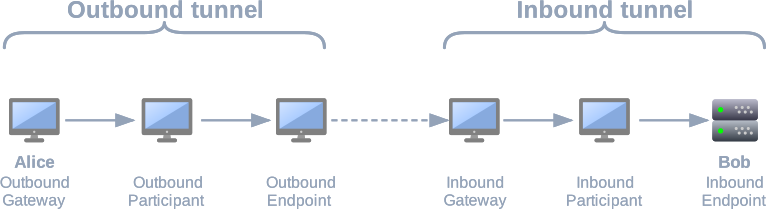
Two types of tunnels exist: “outbound” tunnels send messages away from the tunnel creator, while “inbound” tunnels bring messages to the tunnel creator. Combining these two tunnels allows users to send messages to each other. The sender (“Alice” in the above image) sets up an outbound tunnel, while the receiver (“Bob” in the above image) creates an inbound tunnel. The gateway of an inbound tunnel can receive messages from any other user and will send them on until the endpoint (“Bob”). The endpoint of the outbound tunnel will need to send the message on to the gateway of the inbound tunnel. To do this, the sender (“Alice”) adds instructions to her encrypted message. Once the endpoint of the outbound tunnel decrypts the message, it will have instructions to forward the message to the correct inbound gateway (the gateway to “Bob”).
A third critical concept to understand is I2P’s “network database” (or “netDb”) — a pair of algorithms used to share network metadata. The two types of metadata carried are “routerInfo” and “leaseSets” — the routerInfo gives routers the data necessary for contacting a particular router (their public keys, transport addresses, etc), while the leaseSet gives routers the information necessary for contacting a particular destination. A leaseSet contains a number of “leases”. Each of these leases specifies a tunnel gateway, which allows reaching a specific destination. The full information contained in a lease:
- Inbound gateway for a tunnel that allows reaching a specific destination.
- Time when a tunnel expires.
- Pair of public keys to be able to encrypt messages (to send through the tunnel and reach the destination).
Routers themselves send their routerInfo to the netDb directly, while leaseSets are sent through outbound tunnels (leaseSets need to be sent anonymously, to avoid correlating a router with his leaseSets).
We can combine the above concepts to build successful connections in the network.
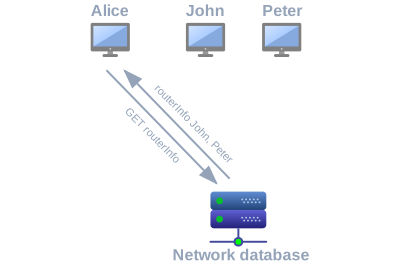
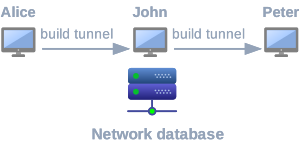
To build up her own inbound and outbound tunnels, Alice does a lookup in the netDb to collect routerInfo. This way, she gathers lists of peers she can use as hops in her tunnels. She can then send a build message to the first hop, requesting the construction of a tunnel and asking that router to send the construction message onward, until the tunnel has been constructed.
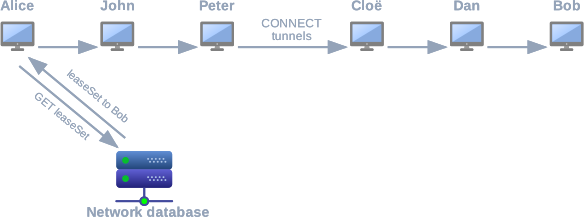
When Alice wants to send a message to Bob, she first does a lookup in the netDb to find Bob’s leaseSet, giving her his current inbound tunnel gateways. She then picks one of her outbound tunnels and sends the message down it with instructions for the outbound tunnel’s endpoint to forward the message on to one of Bob’s inbound tunnel gateways. When the outbound tunnel endpoint receives those instructions, it forwards the message as requested, and when Bob’s inbound tunnel gateway receives it, it is forwarded down the tunnel to Bob’s router. If Alice wants Bob to be able to reply to the message, she needs to transmit her own destination explicitly as part of the message itself. This can be done by introducing a higher-level layer, which is done in the streaming library. Alice may also cut down on the response time by bundling her most recent LeaseSet with the message so that Bob doesn’t need to do a netDb lookup for it when he wants to reply, but this is optional.
While the tunnels themselves have layered encryption to prevent unauthorized disclosure to peers inside the network (as the transport layer itself does to prevent unauthorized disclosure to peers outside the network), it is necessary to add an additional end to end layer of encryption to hide the message from the outbound tunnel endpoint and the inbound tunnel gateway. This “garlic encryption ” lets Alice’s router wrap up multiple messages into a single “garlic message”, encrypted to a particular public key so that intermediary peers cannot determine either how many messages are within the garlic, what those messages say, or where those individual cloves are destined. For typical end to end communication between Alice and Bob, the garlic will be encrypted to the public key published in Bob’s leaseSet, allowing the message to be encrypted without giving out the public key to Bob’s own router.
Another important fact to keep in mind is that I2P is entirely message based and that some messages may be lost along the way. Applications using I2P can use the message oriented interfaces and take care of their own congestion control and reliability needs, but most would be best served by reusing the provided streaming library to view I2P as a streams based network.
Tunnels
Both inbound and outbound tunnels work along similar principles. The tunnel gateway accumulates a number of tunnel messages, eventually preprocessing them into something for tunnel delivery. Next, the gateway encrypts that preprocessed data and forwards it to the first hop. That peer and subsequent tunnel participants add on a layer of encryption after verifying that it isn’t a duplicate before forwarding it on to the next peer. Eventually, the message arrives at the endpoint where the messages are split out again and forwarded on as requested. The difference arises in what the tunnel’s creator does — for inbound tunnels, the creator is the endpoint and they simply decrypt all of the layers added, while for outbound tunnels, the creator is the gateway and they pre-decrypt all of the layers so that after all of the layers of per-hop encryption are added, the message arrives in the clear at the tunnel endpoint.
The choice of specific peers to pass on messages as well as their particular ordering is important to understanding both I2P’s anonymity and performance characteristics. While the network database (below) has its own criteria for picking what peers to query and store entries on, tunnel creators may use any peers in the network in any order (and even any number of times) in a single tunnel. If perfect latency and capacity data were globally known, selection and ordering would be driven by the particular needs of the client in tandem with their threat model. Unfortunately, latency and capacity data is not trivial to gather anonymously, and depending upon untrusted peers to provide this information has its own serious anonymity implications.
From an anonymity perspective, the simplest technique would be to pick peers randomly from the entire network, order them randomly and use those peers in that order for all eternity. From a performance perspective, the simplest technique would be to pick the fastest peers with the necessary spare capacity, spreading the load across different peers to handle transparent failover, and to rebuild the tunnel whenever capacity information changes. While the former is both brittle and inefficient, the later requires inaccessible information and offers insufficient anonymity. I2P is instead working on offering a range of peer selection strategies, coupled with anonymity aware measurement code to organize the peers by their profiles.
As a base, I2P is constantly profiling the peers with which it interacts with by measuring their indirect behavior — for instance, when a peer responds to a netDb lookup in 1.3 seconds, that round trip latency is recorded in the profiles for all of the routers involved in the two tunnels (inbound and outbound) through which the request and response passed, as well as the queried peer’s profile. Direct measurement, such as transport layer latency or congestion, is not used as part of the profile, as it can be manipulated and associated with the measuring router, exposing them to trivial attacks. While gathering these profiles, a series of calculations are run on each to summarize its performance — its latency, capacity to handle lots of activity, whether they are currently overloaded, and how well integrated into the network they seem to be. These calculations are then compared for active peers to organize the routers into four tiers — fast and high capacity, high capacity, not failing, and failing. The thresholds for those tiers are determined dynamically, and while they currently use fairly simple algorithms, alternatives exist.
Using this profile data, the simplest reasonable peer selection strategy is to pick peers randomly from the top tier (fast and high capacity), and this is currently deployed for client tunnels. Exploratory tunnels (used for netDb and tunnel management) pick peers randomly from the “not failing” tier (which includes routers in ‘better’ tiers as well), allowing the peer to sample routers more widely, in effect optimizing the peer selection through randomized hill climbing . These strategies alone do however leak information regarding the peers in the router’s top tier through predecessor and netDb harvesting attacks. In turn, several alternatives exist which, while not balancing the load as evenly, will address the attacks mounted by particular classes of adversaries.
By picking a random key and ordering the peers according to their XOR distance from it, the information leaked is reduced in predecessor and harvesting attacks according to the peers’ failure rate and the tier’s churn. Another simple strategy for dealing with netDb harvesting attacks is to simply fix the inbound tunnel gateway(s) yet randomize the peers further on in the tunnels. To deal with predecessor attacks for adversaries which the client contacts, the outbound tunnel endpoints would also remain fixed. The selection of which peer to fix on the most exposed point would of course need to have a limit to the duration, as all peers fail eventually, so it could either be reactively adjusted or proactively avoided to mimic a measured mean time between failures of other routers. These two strategies can in turn be combined, using a fixed exposed peer and an XOR based ordering within the tunnels themselves. A more rigid strategy would fix the exact peers and ordering of a potential tunnel, only using individual peers if all of them agree to participate in the same way each time. This varies from the XOR based ordering in that the predecessor and successor of each peer is always the same, while the XOR only makes sure their order doesn’t change.
As mentioned before, I2P currently (release 0.8) includes the tiered random strategy above, with XOR-based ordering. A more detailed discussion of the mechanics involved in tunnel operation, management, and peer selection can be found in the tunnel spec .
Network Database (netDb)
As mentioned earlier, I2P’s netDb works to share the network’s metadata. This is detailed in the network database page, but a basic explanation is available below.
All I2P routers contain a local netDb, but not all routers participate in the DHT or respond to leaseset lookups. Those routers that do participate in the DHT and respond to leaseset lookups are called ‘floodfills’. Routers may be manually configured as floodfills, or automatically become floodfill if they have enough capacity and meet other criteria for reliable operation.
Other I2P routers will store their data and lookup data by sending simple ‘store’ and ’lookup’ queries to the floodfills. If a floodfill router receives a ‘store’ query, it will spread the information to other floodfill routers using the Kademlia algorithm . The ’lookup’ queries currently function differently, to avoid an important security issue. When a lookup is done, the floodfill router will not forward the lookup to other peers, but will always answer by itself (if it has the requested data).
Two types of information are stored in the network database.
- A RouterInfo stores information on a specific I2P router and how to contact it
- A LeaseSet stores information on a specific destination (e.g. I2P website, e-mail server…)
All of this information is signed by the publishing party and verified by any I2P router using or storing the information. In addition, the data contains timing information, to avoid storage of old entries and possible attacks. This is also why I2P bundles the necessary code for maintaining the correct time, occasionally querying some SNTP servers (the pool.ntp.org round robin by default) and detecting skew between routers at the transport layer.
Some additional remarks are also important.
Unpublished and encrypted leasesets: One could only want specific people to be able to reach a destination. This is possible by not publishing the destination in the netDb. You will however have to transmit the destination by other means. This is supported by ’encrypted leaseSets’. These leaseSets can only be decoded by people with access to the decryption key.
Bootstrapping: Bootstrapping the netDb is quite simple. Once a router manages to receive a single routerInfo of a reachable peer, it can query that router for references to other routers in the network. Currently, a number of users post their routerInfo files to a website to make this information available. I2P automatically connects to one of these websites to gather routerInfo files and bootstrap. I2P calls this bootstrap process “reseeding”.
Lookup scalability: Lookups in the I2P network are iterative, not recursive. If a lookup from a floodfill fails, the lookup will be repeated to the next-closest floodfill. The floodfill does not recursively ask another floodfill for the data. Iterative lookups are scalable to large DHT networks.
Transport Protocols
Communication between routers needs to provide confidentiality and integrity against external adversaries while authenticating that the router contacted is the one who should receive a given message. The particulars of how routers communicate with other routers aren’t critical — three separate protocols have been used at different points to provide those bare necessities.
I2P currently supports two transport protocols, NTCP2 over TCP, and SSU2 over UDP. These have replaced the previous versions of the protocols, NTCP and SSU , which are now deprecated. Both protocols support both IPv4 and IPv6. By supporting both TCP and UDP transports, I2P can effectively traverse most firewalls, including those intended to block traffic in restrictive censorship regimes. NTCP2 and SSU2 were designed to use modern encryption standards, improve traffic identification resistance, increase efficiency and security, and make NAT traversal more robust. Routers publish each supported transport and IP address in the network database. Routers with access to public IPv4 and IPv6 networks will usually publish four addresses, one for each combination of NTCP2/SSU2 with IPv4/IPv6.
SSU2 supports and extends the goals of SSU. SSU2 has many similarities to other modern UDP-based protocols such as Wireguard and QUIC. In addition to the reliable transport of network messages over UDP, SSU2 provides specialized facilities for peer-to-peer, cooperative IP address detection, firewall detection, and NAT traversal. As described in the SSU spec :
The goal of this protocol is to provide secure, authenticated, semireliable and unordered message delivery, exposing only a minimal amount of data easily discernible to third parties. It should support high degree communication as well as TCP-friendly congestion control and may include PMTU detection. It should be capable of efficiently moving bulk data at rates sufficient for home users. In addition, it should support techniques for addressing network obstacles, like most NATs or firewalls.
NTCP2 supports and extends the goals of NTCP. It provides an efficient and fully encrypted transport of network messages over TCP, and resistance to traffic identification, using modern encryption standards.
I2P supports multiple transports simultaneously. A particular transport for an outbound connection is selected with “bids”. Each transport bids for the connection and the relative value of these bids assigns the priority. Transports may reply with different bids, depending on whether there is already an established connection to the peer.
The bid (priority) values are implementation-dependent and may vary based on traffic conditions, connection counts, and other factors. Routers also publish their transport preferences for inbound connections in the network database as transport “costs” for each transport and address.
Cryptography
I2P uses cryptography at several protocol layers for encryption, authentication, and verification. The major protocol layers are: transports, tunnel build messages, tunnel layer encryption, network database messages, and end-to-end (garlic) messages. I2P’s original design used a small set of cryptographic primitives that at the time were considered secure. These included ElGamal asymmetric encryption, DSA-SHA1 signatures, AES256/CBC symmetric encryption, and SHA-256 hashes. As available computing power increased and cryptographic research evolved substantially over the years, I2P needed to upgrade its primitives and protocols. Therefore, we added a concept of “encryption types” and “signature types”, and extended our protocols to include these identifiers and indicate support. This allows us to periodically update and extend the network support for modern cryptography and future-proof the network for new primitives, without breaking backward compatibility or requiring a “flag day” for network updates. Some signature and encryption types are also reserved for experimental use.
The current primitives used in most protocol layers are X25519 key exchange, EdDSA signatures, ChaCha20/Poly1305 authenticated symmetric encryption, and SHA-256 hashes. AES256 is still used for tunnel layer encryption. These modern protocols are used for the vast majority of network communication. Older primitives including ElGamal, ECDSA, and DSA-SHA1 continue to be supported by most implementations for backward compatibility when communicating with older routers. Some old protocols have been deprecated and/or removed completely. In the near future we will begin research on a migration to post-quantum (PQ) or hybrid-PQ encryption and signatures to maintain our robust security standards.
These cryptographic primitives are combined together to provide I2P’s layered defenses against a variety of adversaries. At the lowest level, inter-router communication is protected by the transport layer security. Tunnel messages passed over the transports have their own layered encryption. Various other messages are passed along inside “garlic messages”, which are also encrypted.
Garlic Messages
Garlic messages are an extension of “onion” layered encryption, allowing the contents of a single message to contain multiple “cloves” — fully formed messages alongside their own instructions for delivery. Messages are wrapped into a garlic message whenever the message would otherwise be passing in cleartext through a peer who should not have access to the information — for instance, when a router wants to ask another router to participate in a tunnel, they wrap the request inside a garlic, encrypt that garlic to the receiving router’s public key, and forward it through a tunnel. Another example is when a client wants to send a message to a destination — the sender’s router will wrap up that data message (alongside some other messages) into a garlic, encrypt that garlic to the public key published in the recipient’s leaseSet, and forward it through the appropriate tunnels.
The “instructions” attached to each clove inside the encryption layer includes the ability to request that the clove be forwarded locally, to a remote router, or to a remote tunnel on a remote router. There are fields in those instructions allowing a peer to request that the delivery be delayed until a certain time or condition has been met, though they won’t be honored until the nontrivial delays are deployed. It is possible to explicitly route garlic messages any number of hops without building tunnels, or even to reroute tunnel messages by wrapping them in garlic messages and forwarding them a number of hops prior to delivering them to the next hop in the tunnel, but those techniques are not currently used in the existing implementation.
Session Tags
As an unreliable, unordered, message based system, I2P uses a simple combination of asymmetric and symmetric encryption algorithms to provide data confidentiality and integrity to garlic messages. The original combination was referred to as ElGamal/AES+SessionTags, but that is an excessively verbose way to describe the simple use of 2048bit ElGamal, AES256, SHA256 and 32 byte nonces. While this protocol is still supported, most of the network has migrated to a new protocol, ECIES-X25519-AEAD-Ratchet. This protocol combines X25519, ChaCha20/Poly1305, and a synchronized PRNG to generate the 32 byte nonces. Both protocols will be briefly described below.
ElGamal/AES+SessionTags
The first time a router wants to encrypt a garlic message to another router, they encrypt the keying material for an AES256 session key with ElGamal and append the AES256/CBC encrypted payload after that encrypted ElGamal block. In addition to the encrypted payload, the AES encrypted section contains the payload length, the SHA256 hash of the unencrypted payload, as well as a number of “session tags” — random 32 byte nonces. The next time the sender wants to encrypt a garlic message to another router, rather than ElGamal encrypt a new session key they simply pick one of the previously delivered session tags and AES encrypt the payload like before, using the session key used with that session tag, prepended with the session tag itself. When a router receives a garlic encrypted message, they check the first 32 bytes to see if it matches an available session tag — if it does, they simply AES decrypt the message, but if it does not, they ElGamal decrypt the first block.
Each session tag can be used only once so as to prevent internal adversaries from unnecessarily correlating different messages as being between the same routers. The sender of an ElGamal/AES+SessionTag encrypted message chooses when and how many tags to deliver, prestocking the recipient with enough tags to cover a volley of messages. Garlic messages may detect the successful tag delivery by bundling a small additional message as a clove (a “delivery status message”) — when the garlic message arrives at the intended recipient and is decrypted successfully, this small delivery status message is one of the cloves exposed and has instructions for the recipient to send the clove back to the original sender (through an inbound tunnel, of course). When the original sender receives this delivery status message, they know that the session tags bundled in the garlic message were successfully delivered.
Session tags themselves have a very short lifetime, after which they are discarded if not used. In addition, the quantity stored for each key is limited, as are the number of keys themselves — if too many arrive, either new or old messages may be dropped. The sender keeps track whether messages using session tags are getting through, and if there isn’t sufficient communication it may drop the ones previously assumed to be properly delivered, reverting back to the full expensive ElGamal encryption.
ECIES-X25519-AEAD-Ratchet
ElGamal/AES+SessionTags required substantial overhead in a number of ways. CPU usage was high because ElGamal is quite slow. Bandwidth was excessive because large numbers of session tags had to be delivered in advance, and because ElGamal public keys are very large. Memory usage was high due to the requirement to store large amounts of session tags. Reliability was hampered by lost session tag delivery.
ECIES-X25519-AEAD-Ratchet was designed to address these issues. X25519 is used for key exchange. ChaCha20/Poly1305 is used for authenticated symmetric encryption. Encryption keys are “double ratcheted” or rotated periodically. Session tags are reduced from 32 bytes to 8 bytes and are generated with a PRNG. The protocol has many similarities to the signal protocol used in Signal and WhatsApp. This protocol provides substantially lower overhead in CPU, RAM, and bandwidth.
The session tags are generated from a deterministic synchronized PRNG running at both ends of the session to generate session tags and session keys. The PRNG is a HKDF using a SHA-256 HMAC, and is seeded from the X25519 DH result. Session tags are never transmitted in advance; they are only included with the message. The receiver stores a limited number of session keys, indexed by session tag. The sender does not need to store any session tags or keys because they are not sent in advance; they may be generated on-demand. By keeping this PRNG roughly synchronized between the sender and recipient (the recipient precomputes a window of the next e.g. 50 tags), the overhead of periodically bundling a large number of tags is removed.
Future
I2P’s protocols are efficient on most platforms, including cell phones, and secure for most threat models. However, there are several areas which require further improvement to meet the needs of those facing powerful state-sponsored adversaries, and to meet the threats of continued cryptographic advances and ever-increasing computing power. Two possible features, restricted routes and variable latency, were proposed by jrandom in 2003. While we no longer plan to implement these features, they are described below.
Restricted Route Operation
I2P is an overlay network designed to be run on top of a functional packet switched network, exploiting the end to end principle to offer anonymity and security. While the Internet no longer fully embraces the end to end principle (due to the usage of NAT), I2P does require a substantial portion of the network to be reachable — there may be a number of peers along the edges running using restricted routes, but I2P does not include an appropriate routing algorithm for the degenerate case where most peers are unreachable. It would, however work on top of a network employing such an algorithm.
Restricted route operation, where there are limits to what peers are reachable directly, has several different functional and anonymity implications, dependent upon how the restricted routes are handled. At the most basic level, restricted routes exist when a peer is behind a NAT or firewall which does not allow inbound connections. This was largely addressed by integrating distributed hole punching into the transport layer, allowing people behind most NATs and firewalls to receive unsolicited connections without any configuration. However, this does not limit the exposure of the peer’s IP address to routers inside the network, as they can simply get introduced to the peer through the published introducer.
Beyond the functional handling of restricted routes, there are two levels of restricted operation that can be used to limit the exposure of one’s IP address — using router-specific tunnels for communication, and offering ‘client routers’. For the former, routers can either build a new pool of tunnels or reuse their exploratory pool, publishing the inbound gateways to some of them as part of their routerInfo in place of their transport addresses. When a peer wants to get in touch with them, they see those tunnel gateways in the netDb and simply send the relevant message to them through one of the published tunnels. If the peer behind the restricted route wants to reply, it may do so either directly (if they are willing to expose their IP to the peer) or indirectly through their outbound tunnels. When the routers that the peer has direct connections to want to reach it (to forward tunnel messages, for instance), they simply prioritize their direct connection over the published tunnel gateway. The concept of ‘client routers’ simply extends the restricted route by not publishing any router addresses. Such a router would not even need to publish their routerInfo in the netDb, merely providing their self signed routerInfo to the peers that it contacts (necessary to pass the router’s public keys).
There are tradeoffs for those behind restricted routes, as they would likely participate in other people’s tunnels less frequently, and the routers which they are connected to would be able to infer traffic patterns that would not otherwise be exposed. On the other hand, if the cost of that exposure is less than the cost of an IP being made available, it may be worthwhile. This, of course, assumes that the peers that the router behind a restricted route contacts are not hostile — either the network is large enough that the probability of using a hostile peer to get connected is small enough, or trusted (and perhaps temporary) peers are used instead.
Restricted routes are complex, and the overall goal has been largely abandoned. Several related improvements have greatly reduced the need for them. We now support UPnP to automatically open firewall ports. We support both IPv4 and IPv6. SSU2 improved address detection, firewall state determination, and cooperative NAT hole punching. SSU2, NTCP2, and address compatibility checks ensure that tunnel hops can connect before the tunnel is built. GeoIP and country identification allow us to avoid peers in countries with restrictive firewalls. Support for “hidden” routers behind those firewalls has improved. Some implementations also support connections to peers on overlay networks such as Yggdrasil.
Variable Latency
Even though the bulk of I2P’s initial efforts have been on low latency communication, it was designed with variable latency services in mind from the beginning. At the most basic level, applications running on top of I2P can offer the anonymity of medium and high latency communication while still blending their traffic patterns in with low latency traffic. Internally though, I2P can offer its own medium and high latency communication through the garlic encryption — specifying that the message should be sent after a certain delay, at a certain time, after a certain number of messages have passed, or another mix strategy. With the layered encryption, only the router that the clove exposed the delay request would know that the message requires high latency, allowing the traffic to blend in further with the low latency traffic. Once the transmission precondition is met, the router holding on to the clove (which itself would likely be a garlic message) simply forwards it as requested — to a router, to a tunnel, or, most likely, to a remote client destination.
The goal of variable latency services requires substantial resources for store-and-forward mechanisms to support it. These mechanisms can and are supported in various messaging applications, such as i2p-bote. At the network level, alternative networks such as Freenet provide these services. We have decided not to pursue this goal at the I2P router level.
Similar Systems
I2P’s architecture builds on the concepts of message oriented middleware, the topology of DHTs, the anonymity and cryptography of free route mixnets, and the adaptability of packet switched networking. The value comes not from novel concepts of algorithms though, but from careful engineering combining the research results of existing systems and papers. While there are a few similar efforts worth reviewing, both for technical and functional comparisons, two in particular are pulled out here — Tor and Freenet.
See also the Network Comparisons Page . Note that these descriptions were written by jrandom in 2003 and may not currently be accurate.
Tor
At first glance, Tor and I2P have many functional and anonymity related similarities. While I2P’s development began before we were aware of the early stage efforts on Tor, many of the lessons of the original onion routing and ZKS efforts were integrated into I2P’s design. Rather than building an essentially trusted, centralized system with directory servers, I2P has a self organizing network database with each peer taking on the responsibility of profiling other routers to determine how best to exploit available resources. Another key difference is that while both I2P and Tor use layered and ordered paths (tunnels and circuits/streams), I2P is fundamentally a packet switched network, while Tor is fundamentally a circuit switched one, allowing I2P to transparently route around congestion or other network failures, operate redundant pathways, and load balance the data across available resources. While Tor offers the useful outproxy functionality by offering integrated outproxy discovery and selection, I2P leaves such application layer decisions up to applications running on top of I2P — in fact, I2P has even externalized the TCP-like streaming library itself to the application layer, allowing developers to experiment with different strategies, exploiting their domain specific knowledge to offer better performance.
From an anonymity perspective, there is much similarity when the core networks are compared. However, there are a few key differences. When dealing with an internal adversary or most external adversaries, I2P’s simplex tunnels expose half as much traffic data than would be exposed with Tor’s duplex circuits by simply looking at the flows themselves — an HTTP request and response would follow the same path in Tor, while in I2P the packets making up the request would go out through one or more outbound tunnels and the packets making up the response would come back through one or more different inbound tunnels. While I2P’s peer selection and ordering strategies should sufficiently address predecessor attacks, should a switch to bidirectional tunnels be necessary, we could simply build an inbound and outbound tunnel along the same routers.
Another anonymity issue comes up in Tor’s use of telescopic tunnel creation, as simple packet counting and timing measurements as the cells in a circuit pass through an adversary’s node exposes statistical information regarding where the adversary is within the circuit. I2P’s unidirectional tunnel creation with a single message so that this data is not exposed. Protecting the position in a tunnel is important, as an adversary would otherwise be able to mount a series of powerful predecessor, intersection, and traffic confirmation attacks.
On the whole, Tor and I2P complement each other in their focus — Tor works towards offering high speed anonymous Internet outproxying, while I2P works towards offering a decentralized resilient network in itself. In theory, both can be used to achieve both purposes, but given limited development resources, they both have their strengths and weaknesses. The I2P developers have considered the steps necessary to modify Tor to take advantage of I2P’s design, but concerns of Tor’s viability under resource scarcity suggest that I2P’s packet switching architecture will be able to exploit scarce resources more effectively.
Freenet
Freenet played a large part in the initial stages of I2P’s design — giving proof to the viability of a vibrant pseudonymous community completely contained within the network, demonstrating that the dangers inherent in outproxies could be avoided. The first seed of I2P began as a replacement communication layer for Freenet, attempting to factor out the complexities of a scalable, anonymous and secure point to point communication from the complexities of a censorship resistant distributed data store. Over time however, some of the anonymity and scalability issues inherent in Freenet’s algorithms made it clear that I2P’s focus should stay strictly on providing a generic anonymous communication layer, rather than as a component of Freenet. Over the years, the Freenet developers have come to see the weaknesses in the older design, prompting them to suggest that they will require a “premix” layer to offer substantial anonymity. In other words, Freenet needs to run on top of a mixnet such as I2P or Tor, with “client nodes” requesting and publishing data through the mixnet to the “server nodes” which then fetch and store the data according to Freenet’s heuristic distributed data storage algorithms.
Freenet’s functionality is very complementary to I2P’s, as Freenet natively provides many of the tools for operating medium and high latency systems, while I2P natively provides the low latency mix network suitable for offering adequate anonymity. The logic of separating the mixnet from the censorship-resistant distributed data store still seems self-evident from an engineering, anonymity, security, and resource allocation perspective, so hopefully the Freenet team will pursue efforts in that direction, if not simply reusing (or helping to improve, as necessary) existing mixnets like I2P or Tor.
Appendix A: Application Layer
I2P itself doesn’t really do much — it simply sends messages to remote destinations and receives messages targeting local destinations — most of the interesting work goes on at the layers above it. By itself, I2P could be seen as an anonymous and secure IP layer, and the bundled streaming library as an implementation of an anonymous and secure TCP layer on top of it. Beyond that, I2PTunnel exposes a generic TCP proxying system for either getting into or out of the I2P network, plus a variety of network applications provide further functionality for end users.
Streaming Library
The I2P streaming library can be viewed as a generic streaming interface (mirroring TCP sockets), and the implementation supports a sliding window protocol with several optimizations, to take into account the high delay over I2P. Individual streams may adjust the maximum packet size and other options, though the default of 4KB compressed seems a reasonable tradeoff between the bandwidth costs of retransmitting lost messages and the latency of multiple messages.
In addition, in consideration of the relatively high cost of subsequent messages, the streaming library’s protocol for scheduling and delivering messages has been optimized to allow individual messages passed to contain as much information as is available. For instance, a small HTTP transaction proxied through the streaming library can be completed in a single round trip — the first message bundles a SYN, FIN and the small payload (an HTTP request typically fits) and the reply bundles the SYN, FIN, ACK and the small payload (many HTTP responses fit). While an additional ACK must be transmitted to tell the HTTP server that the SYN/FIN/ACK has been received, the local HTTP proxy can deliver the full response to the browser immediately.
On the whole, however, the streaming library bears much resemblance to an abstraction of TCP, with its sliding windows, congestion control algorithms (both slow start and congestion avoidance), and general packet behavior (ACK, SYN, FIN, RST, etc).
Naming Library and Address Book
For more information see the Naming and Address Book page.
Developed by: mihi, Ragnarok
Naming within I2P has been an oft-debated topic since the very beginning with advocates across the spectrum of possibilities. However, given I2P’s inherent demand for secure communication and decentralized operation, the traditional DNS-style naming system is clearly out, as are “majority rules” voting systems. Instead, I2P ships with a generic naming library and a base implementation designed to work off a local name to destination mapping, as well as an optional add-on application called the “Address Book”. The address book is a web-of-trust-driven secure, distributed, and human readable naming system, sacrificing only the call for all human readable names to be globally unique by mandating only local uniqueness. While all messages in I2P are cryptographically addressed by their destination, different people can have local address book entries for “Alice” which refer to different destinations. People can still discover new names by importing published address books of peers specified in their web of trust, by adding in the entries provided through a third party, or (if some people organize a series of published address books using a first come first serve registration system) people can choose to treat these address books as name servers, emulating traditional DNS.
I2P does not promote the use of DNS-like services though, as the damage done by hijacking a site can be tremendous — and insecure destinations have no value. DNSsec itself still falls back on registrars and certificate authorities, while with I2P, requests sent to a destination cannot be intercepted or the reply spoofed, as they are encrypted to the destination’s public keys, and a destination itself is just a pair of public keys and a certificate. DNS-style systems on the other hand allow any of the name servers on the lookup path to mount simple denial of service and spoofing attacks. Adding on a certificate authenticating the responses as signed by some centralized certificate authority would address many of the hostile nameserver issues but would leave open replay attacks as well as hostile certificate authority attacks.
Voting style naming is dangerous as well, especially given the effectiveness of Sybil attacks in anonymous systems — the attacker can simply create an arbitrarily high number of peers and “vote” with each to take over a given name. Proof-of-work methods can be used to make identity non-free, but as the network grows the load required to contact everyone to conduct online voting is implausible, or if the full network is not queried, different sets of answers may be reachable.
As with the Internet however, I2P is keeping the design and operation of a naming system out of the (IP-like) communication layer. The bundled naming library includes a simple service provider interface which alternate naming systems can plug into, allowing end users to drive what sort of naming tradeoffs they prefer.
I2PTunnel
Developed by: mihi
I2PTunnel is probably I2P’s most popular and versatile client application, allowing generic proxying both into and out of the I2P network. I2PTunnel can be viewed as four separate proxying applications — a “client” which receives inbound TCP connections and forwards them to a given I2P destination, an “httpclient” (aka “eepproxy”) which acts like an HTTP proxy and forwards the requests to the appropriate I2P destination (after querying the naming service if necessary), a “server” which receives inbound I2P streaming connections on a destination and forwards them to a given TCP host+port, and an “httpserver” which extends the “server” by parsing the HTTP request and responses to allow safer operation. There is an additional “socksclient” application, but its use is not encouraged for reasons previously mentioned.
I2P itself is not an outproxy network — the anonymity and security concerns inherent in a mix net which forwards data into and out of the mix have kept I2P’s design focused on providing an anonymous network which capable of meeting the user’s needs without requiring external resources. However, the I2PTunnel “httpclient” application offers a hook for outproxying — if the hostname requested doesn’t end in “.i2p”, it picks a random destination from a user-provided set of outproxies and forwards the request to them. These destinations are simply I2PTunnel “server” instances run by volunteers who have explicitly chosen to run outproxies — no one is an outproxy by default, and running an outproxy doesn’t automatically tell other people to proxy through you. While outproxies do have inherent weaknesses, they offer a simple proof of concept for using I2P and provide some functionality under a threat model which may be sufficient for some users.
I2PTunnel enables most of the applications in use. An “httpserver” pointing at a webserver lets anyone run their own anonymous website (or “I2P Site”) — a webserver is bundled with I2P for this purpose, but any webserver can be used. Anyone may run a “client” pointing at one of the anonymously hosted IRC servers, each of which are running a “server” pointing at their local IRCd and communicating between IRCds over their own “client” tunnels. End users also have “client” tunnels pointing at I2Pmail’s POP3 and SMTP destinations (which in turn are simply “server” instances pointing at POP3 and SMTP servers), as well as “client” tunnels pointing at I2P’s CVS server, allowing anonymous development. At times people have even run “client” proxies to access the “server” instances pointing at an NNTP server.
I2PSnark
I2PSnark developed: jrandom, et al, ported from mjw ’s Snark client
Bundled with the I2P install, I2PSnark offers a simple anonymous BitTorrent client with multitorrent capabilities, exposing all of the functionality through a plain HTML web interface.
I2Pmail / Susimail
Developed by: postman, susi23, mastiejaner
I2Pmail is more a service than an application — postman offers both internal and external email with POP3 and SMTP service through I2PTunnel instances accessing a series of components developed with mastiejaner, allowing people to use their preferred mail clients to send and receive mail pseudonymously. However, as most mail clients expose substantial identifying information, I2P bundles susi23’s web based susimail client which has been built specifically with I2P’s anonymity needs in mind. The I2Pmail/mail.i2p service offers transparent virus filtering as well as denial of service prevention with hashcash augmented quotas. In addition, each user has control of their batching strategy prior to delivery through the mail.i2p outproxies, which are separate from the mail.i2p SMTP and POP3 servers — both the outproxies and inproxies communicate with the mail.i2p SMTP and POP3 servers through I2P itself, so compromising those non-anonymous locations does not give access to the mail accounts or activity patterns of the user.